Currently Reading

Reading: My Two Polish Grandfathers, by Witold Rybczynski.
Listening to: Blasphemy, by Douglas Preston.
Showing posts with label book reviews. Show all posts

Friday, February 26, 2010

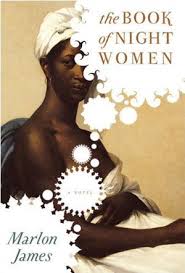
Mary Reviews: The Book of Night Women


James, Marlon. The Book of Night Women. (New York: Riverhead, 2009)

Lilith is born on a sugar plantation in the West Indies just before the turn of the 19th century. She believes that her green eyes, the legacy of a white father, prove that she is better than the other slaves, destined for a different life. She spends her youth and young adulthood pushing against a world that refuses to allow her to realize her limited dreams. Barred from the world of the white masters and mistrusted by slave society, she alternately suppresses and unleashes the anger, violence, and darkness within her.

A summary of this novel can sound trite and timeworn: The unspeakable treatment of slaves is set against the luxurious lifestyle of the masters. A forbidden love affair grows between Lilith and a white overseer. Rebellion is fomented by the Night Women, a group of female slaves.

However, nothing about this novel is what you might expect. The daily life of slaves -- hard work, tedium, horrific and random punishment -- is depicted in a way rarely seen in fiction. The thoughtless cruelty of the white ruling class stuns the reader at every turn. The captivating use of patois creates a strong and rhythmic narrative that holds up from the first page to the last.

The characters in this novel, whether white masters or kitchen slaves, are all too human. None is perfect, and it is difficult to root even for the protagonist, as the author follows her mental and emotional shifts from loyalty to cruelty, from obedience to treachery.

Moving swiftly, pulling the reader into a world of heat, hatred, and dreams of freedom, the novel can, at times, be hard to read, because of its relentless focus on the terror of slavery. It is well worth the effort, though, because this remarkable and disturbing book will change the way you look at the history of slavery in the Americas.

Nominated for the National Book Critics Circle Award. Highly recommended.

Monday, February 15, 2010

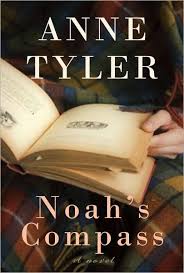
Review: Noah's Compass


Noah's Compass, by Anne Tyler. (New York: Alfred A. Knopf, 2009)

Noah didn't need a compass, Anne Tyler tells us, or sails or other navigational tools, because he wasn't going anywhere. In fact, there was nowhere to go.

Liam Pennywell has been drifting throughout most of his adult life, marrying, having children, taking jobs, but not holding on to anything very well. He has a philosophical attitude about life events, like divorce and job loss, that would be upsetting to others.

When he loses his most recent job, as a fifth grade teacher in a second-rate private school in Baltimore, he thinks about retiring. He's 60 years old, and he believes he can get by if he moves to a smaller apartment and economizes. He pictures spending the last part of his life reading all day in a comfortable chair.

On his first day in his new apartment, he is assaulted by a would-be burglar. He wakes up the next morning in the hospital with a head injury and no memory of the incident. His ex-wife and somewhat distant daughters move back into his life as he begins his recovery, and he comes to realize that he has casually lost hold of memories all his life -- memories of his marriages, of his children, of his ambition.

Liam, like so many of Anne Tyler's characters, tries to maintain his sense of self, even as incidents and individuals outside his control push him to react in uncharacteristic or uncomfortable ways. As she opens up Liam's life to the reader, Tyler shows how we can learn about hope, relationships, and happiness, even from someone like her seemingly rudderless protagonist who is trying only to stay afloat, like Noah.

Recommended.

Tuesday, August 25, 2009

Review: Woodsburner

Pipkin, John. Woodsburner. (New York: Doubleday, 2009)

We all learned about Henry David Thoreau in high school English. His writings (Walden, Civil Disobedience) introduced us to a man with the courage of his convictions, devoted to a simple life in a natural environment, free from the tyranny of powerful government. It may come as a surprise to learn that his neighbors in Concord viewed the young Thoreau as something of an idler, or in his own words in this novel, a wastrel.

First-time novelist John Pipkin draws on an obscure incident in Thoreau's life and uses it as the foundation for a panoramic view of the intellectual, civic, and social environment of mid-18th century New England. In the rain-deprived spring of 1844, Thoreau set fire to the parched woods near Concord. The conflagration destroyed nearly 300 acres of forest and came close to reaching the city.

In addition to the intelligent but vacillating Thoreau, the author introduces us to a number of other well-drawn characters. Eliot is an aspiring playwright, who makes his living running a bookstore paid for by his wealthy father-in-law. Caleb is a fire-and-brimstone preacher who wants to build a new church on the outskirts of Concord. Oddmund is a hardworking and taciturn Norwegian immigrant in love with his employer's wife.

Pipkin's descriptions of the raging fire are dramatic and realistic at the same time. His skillful writing places the reader squarely in the midst of the men desperately fighting to save their property. At the same time, he deftly explores the inner musings of his characters, making them into living, breathing people.

I strongly recommend this novel to readers who appreciate literature and history. What a remarkable debut novel!

Tuesday, June 30, 2009

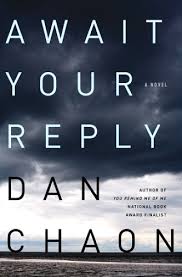
Review: Await Your Reply


Await Your Reply, by Dan Chaon. (New York: Ballantine Books, 2009). Note: Scheduled publication date is September 2009. This review is based on an advanced reading copy.

The notion that we can be anybody we want to be takes on a new twist in this novel of aliases, identity theft, and fraud. Author Dan Chaon roams the permeable boundaries of self, as he demonstrates how easily his characters abandon old lives and assume new ones.

The main character of the novel is Hayden, variously described as a genius and a schizophrenic. We're never sure we meet him directly, though we come to know him through the reminiscences of his identical twin brother, Miles, and through the clues the author drops in the stories of the other characters in the book.

Miles, now 31 years old, has spent the last decade searching for his twin brother, who vanished at 21. He is unable to define his own life's path without knowing where his brother is. Hayden leaves clues to his ever-changing whereabouts in rambling late night phone calls and obscure letters, but Miles is always one step behind him.

Ryan, a college student who is about to flunk out of school, decides that his whole life has been a lie, when he hears some shocking family news. He disappears and begins a new life, on the wrong side of the law, with his uncle.

Lucy is a high school student whose parents died in her sophomore year. She takes to the road after graduation with her history teacher, who promises her a life of riches and excitement.

These stories, fascinating in themselves, are even more intriguing when the author pulls all the threads together. Chaon's character development is excellent, and he has an especially good feel for the young adults he creates. I highly recommend this novel. It's a great combination of literary fiction and a novel of suspense.