Currently Reading

Reading: My Two Polish Grandfathers, by Witold Rybczynski.
Listening to: Blasphemy, by Douglas Preston.
Showing posts with label books. Show all posts

Thursday, February 4, 2010

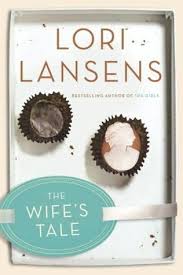
Review: The Wife's Tale


The Wife's Tale, by Lori Lansens. (New York: Little, Brown and Company, 2009)

Obeast.

At the age of nine, Mary Brody overhears the doctor telling her mother that the child is seriously overweight. As she hears it, it is the "obeast" living inside her that causes her to eat and eat and eat. In her new novel, author Lori Lansens again examines the life of someone whose physical self makes her different, outside the norm.

Mary loses weight in high school and attracts tall, smart, hunky basketball player Gooch. When a pregnancy scare drives them to marry right out of high school, Mary begins to build a wall of food and fat around her insecurities. Gooch, who gave up his college scholarship when Mary became pregnant, is devoted to his ever-growing wife, urging her to explore the world outside their small Canadian town with him. Mary's clandestine eating binges and lack of "clothes that fit" lead to her increasing isolation. Finally, on the day of their 25th anniversary, Gooch disappears.

This event proves to be cataclysmic for Mary, who sets out on a journey to find her missing husband and to make up for her unwillingness to participate in the life he dreamed of. An innocent of sorts, she sets out for California and meets agents of help and change everywhere she looks. As she searches for Gooch, she also learns to live in the world without him. She begins to lose weight, along with a lot of other emotional baggage.

In some ways, this novel is a "makeover." The reader almost hopes that Mary will find happiness and accept herself without having to lose her weight, but the author handles the transformation gracefully, without applying overly positive or negative labels to Mary's varying body sizes.

The author is an appealing storyteller. While her storyline sometimes seems a little too pat, she nonetheless brings Mary to life and creates a compelling narrative.

This book is a natural for book clubs. Highly recommended.

Friday, October 30, 2009

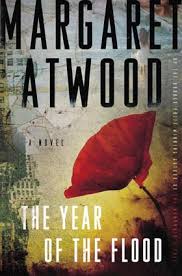
Review: The Year of the Flood

Atwood, Margaret. The Year of the Flood. (New York: Nan A. Talese, 2009)

In this richly imagined world, corporations are in charge, not governments. And the corporations with the most power are those that cater to human desires for beauty and for control over the environment. Genetically engineered products are everywhere, tempting people to look younger, sexier, prettier. New animals, like the Mo'Hair sheep, are designed to provide beauty products (in this case, transplantable hair). People live in corporate compounds, where intelligence is for sale, individuals and families are under company surveillance, and freedom is exchanged for a shaky sense of security and well-being.

Outside the compounds, in the pleeblands, chaos reigns. Violence, poverty, and greed fill every street. The air is bad, buildings are falling down, and gangs roam the streets.

Living in this not-so-distant dystopian future is a cult known as The Gardeners. Led by a charismatic, semi-Christian character known as Adam One, The Gardeners live simply and worship such holy people as Saint Euell Gibbons, Saint E. O. Wilson, and St. Dian Fossey. Vegetarians, they eat "nothing with a face". They honor disappearing species, and they prepare for the "Waterless Flood," a disaster that they anticipate will wipe out most of life on earth.

The storyline centers on two characters. Toby, saved by The Gardeners from a brutal and abusive boss, becomes a practitioner, but reluctant believer. Ren, a teenager when we meet her, moves in and out of The Gardeners' world at the whim of her mother. When her mother leaves The Gardeners and returns to her husband in the HelthWyzer Corporation, we get to experience life inside the corporate compound. Neither Toby nor Ren completely believe in The Gardeners' way of life, but both rely on what they learned, when they find themselves survivors of a deadly plague.

Atwood's creation is visionary, frightening, cautionary, and darkly amusing. Those who have read Oryx and Crake will recognize some characters, as this story takes place at the same time, although from a wholly different perspective.

Highly recommended.

Tuesday, August 25, 2009

Review: Woodsburner

Pipkin, John. Woodsburner. (New York: Doubleday, 2009)

We all learned about Henry David Thoreau in high school English. His writings (Walden, Civil Disobedience) introduced us to a man with the courage of his convictions, devoted to a simple life in a natural environment, free from the tyranny of powerful government. It may come as a surprise to learn that his neighbors in Concord viewed the young Thoreau as something of an idler, or in his own words in this novel, a wastrel.

First-time novelist John Pipkin draws on an obscure incident in Thoreau's life and uses it as the foundation for a panoramic view of the intellectual, civic, and social environment of mid-18th century New England. In the rain-deprived spring of 1844, Thoreau set fire to the parched woods near Concord. The conflagration destroyed nearly 300 acres of forest and came close to reaching the city.

In addition to the intelligent but vacillating Thoreau, the author introduces us to a number of other well-drawn characters. Eliot is an aspiring playwright, who makes his living running a bookstore paid for by his wealthy father-in-law. Caleb is a fire-and-brimstone preacher who wants to build a new church on the outskirts of Concord. Oddmund is a hardworking and taciturn Norwegian immigrant in love with his employer's wife.

Pipkin's descriptions of the raging fire are dramatic and realistic at the same time. His skillful writing places the reader squarely in the midst of the men desperately fighting to save their property. At the same time, he deftly explores the inner musings of his characters, making them into living, breathing people.

I strongly recommend this novel to readers who appreciate literature and history. What a remarkable debut novel!

Friday, December 19, 2008

Review: Life After Genius


Life After Genius, by M. Ann Jacoby. (New York: Grand Central Publishing, 2008)

Mead Fegley is the kind of kid that other kids love to pick on. He's smaller than average, he lacks social graces, and he's a math genius. He heads off to college after graduating from high school at age 15, hoping that his life will change and that his fellow students will appreciate him for his intellectual talents. He continues to excel academically, but his youth and his awkward ways prevent him from developing real friendships.

This book works very well as a coming-of-age story. Mead is self-centered and introspective, in the way that most children and adolescents are, but his outsize intelligence exaggerates these qualities. He is bright and engaging and even likable in his internal musings, but becomes sarcastic and supercilious when he tries to relate to others. The author capably illustrates the difficulties faced by a child who stands out in a small town. Townspeople invariably categorize him as "the young Fegley genius."

Where the book falters is in Jacoby's treatment of Mead's life as a college student. He works hard and is singled out for academic honors, but he appears to suffer from some delusional episodes. In his relationship with Herman, his academic rival and social superior, the reader is hard pressed to distinguish between what is real and what is not.

I'm a sucker for a great title, but Life After Genius promises more than it delivers. The story is told mostly in flashbacks, after Mead inexplicably leaves college for his hometown a few days before graduation, but the reader never really learns whether or how Mead will conduct his life outside his carefully constructed world of mathematical genius.

While the book is interesting and, in some parts, quite compelling, overall, it suffers from inconsistencies and, perhaps, too ambitious a storyline. Jacoby could have saved some of the plot twists for other books and made this one simpler and more enjoyable. Nonetheless, I recommend it to readers of general fiction.

Thursday, August 7, 2008

Choosing Books

I'm always interested in learning how people go about selecting books, especially people outside my field. We librarians have infinite resources that alert us to titles new and old. Sometimes, though, having such access can discourage me from reading a book I might actually enjoy. For instance, if I see a less than enthusiastic review of a book that initially appeared to be interesting, I usually pass it by and look for something else. Is it wise, though, to rely so heavily on the opinion of one reviewer? After all, if you look hard enough, you can find both good and bad reviews of the very same titles.

Summertime brings out the browser in me. When I'm heading out on vacation, my selections are heavily influenced by reviewer quotes that say something like, "I couldn't put it down." I love the idea of being swallowed up by the writer's world when my own life takes a quiet and lazy turn. One of my vacation books this summer was The Sister, by Poppy Adams, a modern Gothic with odd characters, a creepy old house, and plenty of twists in the storyline.

Come fall, though, I begin to look for the nominees for literary prizes. I print out the lists and use them as the basis for my library reserves for months to come. The National Book Awards, the Pulitzers, PEN/Faulkner, and the genre awards provide hours and hours of great reading. Early in the year, the professional library journals post their lists of notable titles, and they carry me right through the spring!

Saturday, August 2, 2008


Review: The Wednesday Sisters

The Wednesday Sisters, by Meg Waite Clayton.
(Ballantine Books, 2008. ISBN:
0345502825)

A group of young mothers meet in a park in Palo Alto in 1968. Over the next few years, they share personal triumphs and tragedies, all while working together to develop their writing skills. Their catalog of woes ranges from infidelity and infertility to cancer.

The characters observe and sometimes participate in the many events that changed the country during those disruptive years. What makes this story different from so many others that focus on that time period is the perspective from which it is told. The young women are wives and mothers, engaged in the traditional roles of supporting their upwardly-mobile husbands and raising their children. Most novels set in the late 1960’s feature characters that are more directly and actively engaged in the political and social upheaval of the time.

A light read with a rather predictable story line, The Wednesday Sisters is nonetheless notable for its reflections on the many changes in the roles of women in society over the last few decades. Younger readers may be surprised to learn about the demonstrations outside the Miss America Pageant and to read about women athletes who were barred from competing in the Boston Marathon.

Women's book discussion books may want to consider this title.


Friday, July 18, 2008

Review: Swim to Me

Swim to Me, by Betsy Carter.
(Algonquin Books of Chapel Hill, 2007, ISBN: 1565124928)

Once upon a time, before Disney World and Universal Studios became defining destinations, visitors to Florida found unusual attractions down every road. One of them was (and still is) Weeki Wachee Springs, featuring a "city of live mermaids." The author's story is an invention that fits snugly into the real history of the site and its performers.

Delores is a girl from the Bronx who loves to swim and who dreams of becoming a Weeki Wachee mermaid. She finds more success than she ever imagined, becoming a weather girl for a local TV station (forecasting from a bathtub in her mermaid tail) and, ultimately, the star of a combination circus/aquatic show. The fairy tale quality of the book is balanced by the back story of her unhappy family life and the breakup of her parents' marriage.

The novel takes place around 1970, and it is full of product and song placements that will make readers of a certain age smile with recollection.

Disney World has just opened as the story comes to its climax, and Walker chooses to focus on the success that Weeki Wachee Springs achieves in putting on a fabulous new show that produces jealousy in Walt Disney himself. Left unspoken is what every reader knows: that Disney's creation will come to dwarf attractions like the one in the book.

An excellent choice for book clubs.

Tuesday, July 15, 2008

Review: This Must Be the Place


This Must Be the Place, by Anna Winger
(Riverhead Books, 2008, ISBN 978-1-59448-997-6)

The main characters in this "coming of middle age" novel are Walter, once a German TV heartthrob, now the German voice of Tom Cruise, and Hope, an American living not very happily in Berlin with her traveling businessman husband. A third character is the city itself, where past and present live side by side -- modern structures alongside bombed-out lots and once-glamorous buildings.

Walter, at nearly forty, is still trying to reconcile the pieces of his life: an American mother, whom he later learns was Jewish; his German father; his estranged grandparents; his early success on German television; and his failed attempt to make it in Hollywood.

Hope has followed her husband to Berlin after the events of September 11. The novel examines her growing dissatisfaction with her marriage and the loss that has her sleepwalking through her life. Her friendship with Walter grows, as her husband leaves her alone for weeks at a time, while he pursues his business dealings in Poland.

First novelist Winger has a great sense of humor. Hope's husband congratulates himself for building up the economy of Poland by sponsoring late night pay-per-view naked wrestling matches, featuring former Polish prostitutes, on German television. Walter's courtship of Hope is filled with scenes both comic and touching. My favorite quote: "[Walter] felt pleased with himself; he had never dated a woman old enough to remember REO Speedwagon, let alone dislike them."

The book I read was a prepub version. According to the back cover, the novel is due out in August.