Currently Reading

Reading: My Two Polish Grandfathers, by Witold Rybczynski.
Listening to: Blasphemy, by Douglas Preston.

Friday, December 19, 2008

Review: Life After Genius


Life After Genius, by M. Ann Jacoby. (New York: Grand Central Publishing, 2008)

Mead Fegley is the kind of kid that other kids love to pick on. He's smaller than average, he lacks social graces, and he's a math genius. He heads off to college after graduating from high school at age 15, hoping that his life will change and that his fellow students will appreciate him for his intellectual talents. He continues to excel academically, but his youth and his awkward ways prevent him from developing real friendships.

This book works very well as a coming-of-age story. Mead is self-centered and introspective, in the way that most children and adolescents are, but his outsize intelligence exaggerates these qualities. He is bright and engaging and even likable in his internal musings, but becomes sarcastic and supercilious when he tries to relate to others. The author capably illustrates the difficulties faced by a child who stands out in a small town. Townspeople invariably categorize him as "the young Fegley genius."

Where the book falters is in Jacoby's treatment of Mead's life as a college student. He works hard and is singled out for academic honors, but he appears to suffer from some delusional episodes. In his relationship with Herman, his academic rival and social superior, the reader is hard pressed to distinguish between what is real and what is not.

I'm a sucker for a great title, but Life After Genius promises more than it delivers. The story is told mostly in flashbacks, after Mead inexplicably leaves college for his hometown a few days before graduation, but the reader never really learns whether or how Mead will conduct his life outside his carefully constructed world of mathematical genius.

While the book is interesting and, in some parts, quite compelling, overall, it suffers from inconsistencies and, perhaps, too ambitious a storyline. Jacoby could have saved some of the plot twists for other books and made this one simpler and more enjoyable. Nonetheless, I recommend it to readers of general fiction.

Tuesday, December 9, 2008

Brief Review: The Story of Edgar Sawtelle


The Story of Edgar Sawtelle, by David Wroblewski. (New York: Ecco, 2008)

This Oprah selection is showing up on all the Best of 2008 lists. Both Stephen King and Richard Russo, two very different kinds of writers, wrote recommendations for the back cover of the book, and that's what made me decide to read it. I'm a little more than halfway through, so this may be a premature post, but I'm finding it to be an engaging story with remarkable characters.

Edgar is born without the ability to speak, although he is normal in every other way. A precocious child, he reads early and learns sign language to communicate with his parents. His parents, by the way, are the second generation breeders of an unusual kind of dog, one whose pedigree is based on character and personality, rather than thoroughbred lines.

Oprah's recommendation will be enough to encourage book clubs everywhere to take on this novel. Read this even if you're the kind of reader who stays away from the popular stuff. There's a lot to appreciate -- imagery, character development, story line -- in The Story of Edgar Sawtelle.

Saturday, November 29, 2008

Review: The 19th Wife


The 19th Wife, by David Ebershoff. (New York: Random House, c2008.)

Ebershoff explores the impact of polygamy on women and children in this complex novel of interwoven narratives. He tells the story of Ann Eliza Young, apostate ex-wife of Brigham Young, alongside the story of Jordan Scott, an excommunicated member of the "Firsts," a modern-day offshoot of the Latter Day Saints whose adherents continue to practice plural marriage.

Ann Eliza's story is historical fiction, finding its basis in her actual lectures and writings from the late 1800's. At that time, the Saints had settled in Salt Lake City and, under the leadership of Prophet Brigham Young, had developed a thriving, if insulated, society. Women were instructed, according to the vision of First Prophet Joseph Smith, that polygamy, or "celestial marriage," was a divine requirement for their salvation.

The author effectively portrays the contrast between the official picture of Mormon "sister wives," contentedly sharing housework and raising their children together, and Ann Eliza's experience of plural marriage, which she finds to be degrading to women, as well as to their children. Her lectures in theaters and auditoriums across the country, and her testimony before Congress, helped lead to legislation outlawing polygamy. Ironically, her very public apostasy may also have helped the Church of Jesus Christ of Latter Day Saints survive into the present, owing to their denunciation of plural marriage at the end of the 19th century.

The author weaves a separate contemporary story into the historical one. In this story, a gay teenager, Jordan Scott, is expelled from the polygamist group known as "The Firsts." The Firsts live in Mesadale in the Utah desert, far from the scrutiny of the federal government. (Ironically, Jordan is expelled not for being gay, but for holding hands with a teenaged girl.)

This part of the story begins when Jordan's father is shot to death, and his mother, the 19th wife of his father, is jailed for the murder. Jordan, who had been abandoned by his mother by order of the Prophet, returns to Mesadale to help her win her freedom from prison.

This book is very well written and it works beautifully as a novel, but it also provides a fascinating account of the practice and politics of polygamy. Highly recommended.

Sunday, November 23, 2008

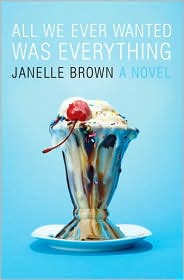
Review: All We Ever Wanted Was Everything (Audio)


All We Ever Wanted Was Everything, by Janelle Brown. (Spiegel & Grau, 2008. ISBN: 0385524013)

On the surface, Janice’s life is great. She has the beautiful home, the successful husband, two smart and lovely daughters. Although she paints a beautiful picture of her family when she talks to her friends, she’s never really satisfied.

Her husband, who stands to make billions from the launch of an IPO for his pharmaceutical company, is never home. Her older daughter, Margaret – incredibly smart, an Ivy League grad – ran off to LA with an actor, no less, and started up a weird feminist magazine. Her younger daughter, Lizzie, her miracle baby, born after several miscarriages, is a sweet, but rather plump, 14-year-old. Janice knows that Lizzie would be much happier and more popular, if only she’d drop a few pounds.

On the day of the IPO, everything falls apart. Over the course of a summer, Janice and her daughters find themselves dealing with issues they’d never dreamed of discovering in their own lives: drug addiction, debt collectors, infidelity, teen pregnancy, and divorce papers.

The author’s satirical look at the good life in California is sometimes funny, often bitter, and always apt. She does a good job of distinguishing her characters with unique and believable voices.

I listened to this book on OverDrive’s downloadable audio from the Lackawanna County Library System’s digital collection. Recommended for book clubs.


Saturday, November 15, 2008

Michael Beschloss


Presidential Historian Michael Beschloss paid a visit to Scranton this week, as a speaker in the Lackawanna County Library Lecture Series. He spoke for the better part of an hour, telling stories of the presidents he has written about in his books. He was charming, intelligent, and funny. If you ever have a chance to attend one of his lectures, be sure to go!

It was his first visit to what he called "the epicenter" of the 2008 presidential campaign, and he spent some time trading jokes with former Scranton Mayor Jim Connors about whether Scranton or Chicago had the worse reputation for political shenanigans. (In my opinion, Mayor Connors got off the best line, when he described someone who wants to be buried in Scranton when he dies, so he can remain active in politics.)

In the meantime, you may want to read his newest book, Presidential Courage, in which he describes moments in the lives of nine American Presidents when they had to choose between the right thing to do and the possibility of losing reelection. The vignettes are necessarily brief, but they provide insight into such events as Theodore Roosevelt's antitrust attack on the Northern Securities Company, Harry Truman's actions in the creation of the nation of Israel, and John F. Kennedy's support for the Civil Rights Act.

Monday, October 20, 2008

National Book Awards Finalists

The National Book Foundation has announced the finalists for the 2008 National Book Awards. The fiction list is:

Aleksandar Hemon, The Lazarus Project (Riverhead)
Rachel Kushner, Telex from Cuba (Scribner)
Peter Matthiessen, Shadow Country (Modern Library)
Marilynne Robinson, Home (Farrar, Straus & Giroux)
Salvatore Scibona, The End (Graywolf Press)

To see the nominees in Nonfiction, Poetry, and Young People's Literature, go to the 2008 Awards page.

Tuesday, October 14, 2008

Man Booker Prize Winner Announced

The White Tiger, by Aravind Adiga, has won the 2oo8 Man Booker Prize. For more information, see the announcement on the official website.