Currently Reading

Reading: My Two Polish Grandfathers, by Witold Rybczynski.
Listening to: Blasphemy, by Douglas Preston.

Saturday, November 7, 2009

Review: Under the Persimmon Tree

Staples, Suzanne Fisher. Under the Persimmon Tree. (New York: Farrar, Straus and Giroux, 2005.)

This story engaged me from page one. The author combines a compelling story with informative and illustrative scenes of war and life in the mountains of Afghanistan, in refugee camps, and in Peshawar, Pakistan.

We learn about the unpredictability of life under Taliban rule and of the random horror of American bombing raids from the story of Najmah. The young Afghani girl loses her family and finds herself reluctantly fleeing her home and her country to seek safety in Pakistan.

At the same time, we hear the story of Nusrat, an American woman (nee Elaine) who fell in love with an Afghani doctor in New York. She converts to Islam, marries him, and returns with him to Pakistan, where his family has sought refuge from the war. When he leaves to staff a medical clinic in embattled Afghanistan, Nusrat stays behind, where she teaches refugee children and grows ever closer to her husband's family.

Eventually, these two stories connect, but not before the author takes the time to explore the different ways that the two protagonists react to family, loss, and love. Najmah is defined by her strong connection to her family and to her mountain home. She is determined to return there, despite incredible dangers, no matter what. Nusrat, on the other hand, leaves behind the family she knows to create a life with her husband and his family in a new land.

Under the Persimmon Tree was named an ALA Notable Children's Book for Older Readers. Highly recommended.

Friday, October 30, 2009

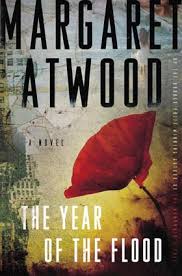
Review: The Year of the Flood

Atwood, Margaret. The Year of the Flood. (New York: Nan A. Talese, 2009)

In this richly imagined world, corporations are in charge, not governments. And the corporations with the most power are those that cater to human desires for beauty and for control over the environment. Genetically engineered products are everywhere, tempting people to look younger, sexier, prettier. New animals, like the Mo'Hair sheep, are designed to provide beauty products (in this case, transplantable hair). People live in corporate compounds, where intelligence is for sale, individuals and families are under company surveillance, and freedom is exchanged for a shaky sense of security and well-being.

Outside the compounds, in the pleeblands, chaos reigns. Violence, poverty, and greed fill every street. The air is bad, buildings are falling down, and gangs roam the streets.

Living in this not-so-distant dystopian future is a cult known as The Gardeners. Led by a charismatic, semi-Christian character known as Adam One, The Gardeners live simply and worship such holy people as Saint Euell Gibbons, Saint E. O. Wilson, and St. Dian Fossey. Vegetarians, they eat "nothing with a face". They honor disappearing species, and they prepare for the "Waterless Flood," a disaster that they anticipate will wipe out most of life on earth.

The storyline centers on two characters. Toby, saved by The Gardeners from a brutal and abusive boss, becomes a practitioner, but reluctant believer. Ren, a teenager when we meet her, moves in and out of The Gardeners' world at the whim of her mother. When her mother leaves The Gardeners and returns to her husband in the HelthWyzer Corporation, we get to experience life inside the corporate compound. Neither Toby nor Ren completely believe in The Gardeners' way of life, but both rely on what they learned, when they find themselves survivors of a deadly plague.

Atwood's creation is visionary, frightening, cautionary, and darkly amusing. Those who have read Oryx and Crake will recognize some characters, as this story takes place at the same time, although from a wholly different perspective.

Highly recommended.

Tuesday, August 25, 2009

Review: Woodsburner

Pipkin, John. Woodsburner. (New York: Doubleday, 2009)

We all learned about Henry David Thoreau in high school English. His writings (Walden, Civil Disobedience) introduced us to a man with the courage of his convictions, devoted to a simple life in a natural environment, free from the tyranny of powerful government. It may come as a surprise to learn that his neighbors in Concord viewed the young Thoreau as something of an idler, or in his own words in this novel, a wastrel.

First-time novelist John Pipkin draws on an obscure incident in Thoreau's life and uses it as the foundation for a panoramic view of the intellectual, civic, and social environment of mid-18th century New England. In the rain-deprived spring of 1844, Thoreau set fire to the parched woods near Concord. The conflagration destroyed nearly 300 acres of forest and came close to reaching the city.

In addition to the intelligent but vacillating Thoreau, the author introduces us to a number of other well-drawn characters. Eliot is an aspiring playwright, who makes his living running a bookstore paid for by his wealthy father-in-law. Caleb is a fire-and-brimstone preacher who wants to build a new church on the outskirts of Concord. Oddmund is a hardworking and taciturn Norwegian immigrant in love with his employer's wife.

Pipkin's descriptions of the raging fire are dramatic and realistic at the same time. His skillful writing places the reader squarely in the midst of the men desperately fighting to save their property. At the same time, he deftly explores the inner musings of his characters, making them into living, breathing people.

I strongly recommend this novel to readers who appreciate literature and history. What a remarkable debut novel!

Sunday, August 16, 2009

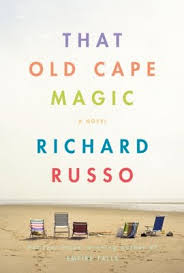
Review: That Old Cape Magic

Russo, Richard. That Old Cape Magic. (New York: Alfred A. Knopf, 2009)

Marriages and weddings provide the dramatic backdrop for the latest novel by Pulitzer Prize-winning author Richard Russo. Fifty-five year old Jack Griffin watches as his thirty-year marriage to Joy quietly unravels. At the same time, he finds himself obsessed with remembering the eccentric and ultimately unsuccessful marriage of his late parents. The story opens with Griffin and Joy arriving separately at the wedding of a friend on Cape Cod, where they had honeymooned. Their daughter announces her engagement there, with her wedding to take place a year hence, in Maine.

In the course of that year, Griffin and Joy separate, Griffin's mother dies, and Griffin carries the ashes of both parents in the trunk of his car, unable to bring himself to dispose of them. Meanwhile, he reminisces about his childhood visits to the Cape with his parents, and he recollects scenes of his life with them. His "conversations" with them, even though they are dead, are more real to him than what happens around him.

Russo paints hilarious portraits of Griffin's Ivy League-educated parents who spend their careers teaching in a large state university in Indiana. Their devotion to Cape Cod and their competitive marriage provide plenty of opportunities for comedy and irony. The wedding of Griffin's daughter is another laugh-out-loud episode in this novel.

Set against the humor, though, is Russo's serious examination of what holds a marriage together and his illustration of how easy it is -- through lack of communication or pride -- to let go of a union built by two loving people over many years.

This book is more reminiscent of Russo's Straight Man than of his novels of middle class life set in New England and New York, like Empire Falls. It is also considerably briefer than many of his books, but it is funny, meaningful, and satisfying. Highly recommended.

Monday, August 3, 2009

Lackawanna County Library System Hosts Junior Battle of the Books

Teams of readers from all over Lackawanna County will compete in the Junior Battle of the Books on Thursday, August 6 at 6:30 at the Moscow Borough Building, next door to the North Pocono Public Library. The event is for kids in Grades 4 through 6.

I've spent the last week catching up on my reading for this age group, since I'm going to be one of the judges. I've read four great books, selected by the LCLS youth services librarians.

The first book I read was Jeff Kinney's Diary of a Wimpy Kid. This very popular book is the first in a series that features Greg, who records his experiences and thoughts about sixth grade. His stories about popularity, friendship, and family are both funny and true.

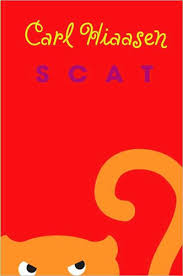
Next, I read Scat. In this book, Nick and his friend Marta find themselves swept up in a mystery that includes an endangered species, a wildfire, and their biology teacher. The book is written by Carl Hiaasen, best known for his mysteries for grownups.

I'm almost finished with The Watsons Go to Birmingham, 1963, by Christopher Paul Curtis. Ten-year-old Kenny Watson and his family live in Flint, Michigan. They head south to visit his grandmother in Birmingham, Alabama, during one of the most frightening times in the Civil Rights movement.

I have one more book to read before Thursday. It's called Chasing Vermeer, and it was written by Blue Balliett. It's another mystery, this time about the disappearance of a famous painting.

So far, all the books I've read have been really good and very interesting. The librarians did a great job of picking books that are appealing, fun to read, and full of good information. If you're in Grades 4 to 6, or if you know someone who is, I recommend that you read these books. They are all available at the Lackawanna County Library System library closest to you.

Thursday, July 30, 2009

Netflix vs. RedBox vs. Blockbuster -- What's the Best Deal?

According to the Cheapskate Blog, it's your public library! Read all about it here, and then visit the library to pick up your weekend movies.

What's the Best Deal?

Saturday, July 25, 2009

Review: Let the Great World Spin


McCann, Colum. Let the Great World Spin. (New York: Random House, 2009)

On the morning of August 7, 1974, Philippe Petit strung a wire between the new, not entirely occupied, twin towers of the World Trade Center in New York City. He proceeded to step out onto the wire, a quarter of a mile above the pavement, and walk across, eight times, for a period of 45 minutes, while office workers, commuters, and police looked on in wonder, admiration, and consternation.

Colum McCann tells the story of this aerial crime, enriching it with the stories of ten people who saw or were affected by the aerialist's action that day, including an Irish-born "street priest" in the South Bronx and his brother; Petit's sentencing judge, his wife, and son; mother/daughter hookers; and computer programmers on the West Coast. The reader is treated to a series of narratives that could stand alone as short stories, but that are, in the end, interconnected on the day of Philippe Petit's performance.

The novel introduces a stunning variety of social and historical issues that played out in the decade of the 1970's. The breakdown of social class is seen in the coming together of a group of mothers, mourning the loss of their sons in the Vietnam War, while celebrating their lives. The effects of poverty and drug addiction on women and children are illustrated by the "family business" of prostitution. The power of interlinked computers and telecommunications was in its infancy and creating excitement among the programmers who were thinking and dreaming big. The Vietnam War, moving towards its close in 1974, divided friends and family in New York City and elsewhere. The World Trade Center towers, newly constructed and occupied, represent a beginning in this novel, rather than the iconic destruction and terror we associate with them today.

Reading this novel, I was struck by the vast changes in communication between 1974 and the present. The Manhattanites on the sidewalk looking up at Petit paused in their busy lives to try to figure out what was happening 110 stories above them. They could not check CNN or their smart phones, as we would do today. They couldn't go online when they got to work to learn about what they'd seen. Computer programmers on the West Coast, who heard rumors of Petit's stunt, hacked into the phone system and began calling pay phones in New York City, hoping someone would pick up and tell them what was happening. In the era of the 24-hour news cycle and the Internet, it is hard to imagine how slowly, just 35 years ago, a sensational story could develop.

This book is extraordinary -- for its writing, for its depiction of 1970's New York, and for the way it captures the emotions of the lives being lived in its pages. Highly recommended.